Honest, useful guides
Trustwallet app is a self-custody Web3 wallet with SWIFT account abstraction
Trustwallet app is a mobile and desktop crypto wallet for holding digital assets, using DeFi, viewing NFTs, and accessing SWIFT smart contract wallet features inside the Trust Wallet ecosystem. It gives users direct control of their private keys while supporting swaps, staking, token purchases, market data, real-world asset tokens, perpetual futures, and prediction markets from one wallet interface.
SWIFT makes the wallet more approachable for DeFi actions
The most distinctive angle is SWIFT, Trust Wallet's smart contract wallet experience built around account abstraction. A conventional crypto wallet signs one transaction at a time from an externally owned account. A smart contract wallet adds programmable account logic, so the interface is better suited to bundled actions, recovery improvements, and smoother Web3 interactions.
That matters when a user moves from simple holding into DeFi. Swapping a token, approving a contract, bridging value, claiming a position, or interacting with a market creates more friction than sending Bitcoin or Ethereum to another address. The Trustwallet app uses this account-abstraction direction to make those steps feel closer to an application flow while preserving self-custody as the foundation.
What the app actually manages on-chain
It works as a multi-chain wallet for coins, tokens, NFTs, and Web3 positions. Assets still live on their blockchains; the app displays balances, constructs transactions, stores the keys or signing credentials needed to authorize activity, and connects to dApps. That distinction explains why an incoming transfer sometimes appears only after the right network or token contract is shown in the wallet.
Trust Wallet is associated with broad chain support across major ecosystems such as Bitcoin, Ethereum, BNB Smart Chain, Solana, Polygon, and many other networks. The app also includes market prices and a converter, so a holder can read balances in familiar currency terms without leaving the wallet.
Buying, swapping, staking, and browsing from the same account
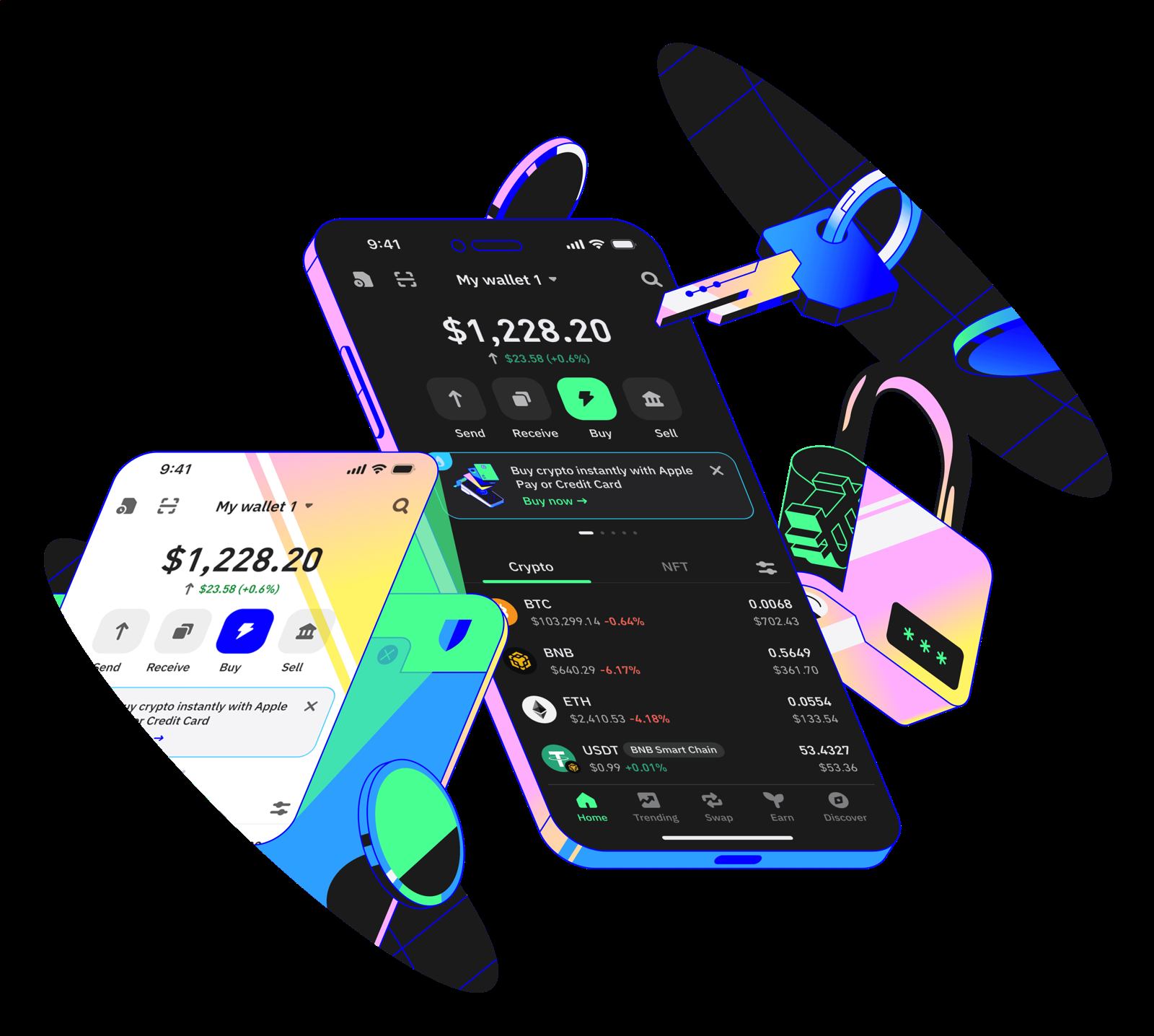
The Trustwallet app brings several common crypto actions into one surface. Users buy crypto through integrated providers, swap tokens through supported routes, stake eligible assets to participate in network security , and open Web3 apps through mobile or browser-extension workflows. The goal is practical: fewer jumps between an exchange account, a separate portfolio tracker, and a wallet connector.
These actions still settle on public networks or through third-party liquidity and payment providers. Network fees, liquidity spreads, validator rules, and contract approvals remain part of the experience. The cleaner interface does not erase those mechanics; it makes them easier to inspect before signing.
- Buy crypto with supported payment methods and provider availability.
- Swap tokens across available liquidity routes inside the wallet flow.
- Stake eligible proof-of-stake assets where network support is available.
- Store and view NFTs connected to supported chains and collections.
- Use the browser extension for desktop Web3 sessions.
Private keys, recovery phrases, and what self-custody changes
Self-custody means the user controls the wallet's signing authority. In a seed-phrase wallet, that recovery phrase follows BIP39-style word counts such as 12 or 24 words, and anyone who has it controls the funds. SWIFT changes the account model for supported flows, but the same principle remains: signing access is the critical asset.
The Trustwallet app is designed around privacy and security messaging, yet wallet safety depends heavily on user behavior. The most important routine is boring and strict: store recovery material offline, reject support messages asking for secrets, read token approvals before granting them, and confirm that the sending network matches the receiving asset.
Why transfers sometimes look missing after they succeeded
A common wallet confusion comes from network mismatch. Someone sends ETH from an exchange and expects to see native Ethereum, but the exchange sends a wrapped version on BNB Smart Chain or another network. The blockchain transaction succeeds, yet the visible balance does not match the asset the user is watching.
When that happens, the transaction hash, sender network, receiving address, and token contract reveal the answer. Trustwallet app users should check whether the token needs to be added manually, whether the correct chain is selected, and whether the exchange withdrawal used ERC-20, BEP-20, Solana, Polygon, or another supported route. Waiting helps only when the network is congested; it does not fix a wrong-chain transfer by itself.
Where NFTs, RWAs, perps, and prediction markets fit
Trust Wallet has expanded beyond the older pattern of sending coins and collecting tokens. The current product surface includes NFTs, tokenized real-world assets, perpetual futures, and prediction market access through supported Web3 integrations. Those categories serve different users: an NFT collector wants collection visibility, a DeFi user wants swaps and staking, and an active trader wants market access without moving assets to a custodial exchange.
The Trustwallet app should be treated as an access layer for those markets, not as a guarantee that every asset or contract is high quality. Tokenized assets, perps, and prediction markets introduce market, contract, and liquidation risks that simple spot holding does not create. The wallet gives the signing and viewing interface; the user still signs the transaction that enters the position.
Mobile app and browser extension workflows
The mobile app is the natural fit for everyday balances, QR-code payments, swaps, NFT viewing, and quick Web3 access. The browser extension is better for desktop DeFi sessions, especially when a dApp is designed around a full-size screen. Both approaches connect the same broad idea: the wallet is the account layer, and the dApp is the destination.
A practical setup starts with installing the official app or extension, creating or importing a wallet, securing the recovery method, adding the chains and tokens actually used, then testing with a small transfer before moving larger balances. Once the account is ready, the user connects to dApps, checks permissions, signs only transactions they understand, and disconnects stale sessions when the work is done.

MetaMask, Coinbase Wallet, Phantom, and where Trust Wallet stands
Trustwallet app competes most directly with other self-custody wallets, but each has a different center of gravity. MetaMask is deeply established for Ethereum and EVM networks. Coinbase Wallet has strong familiarity for users who already know the Coinbase brand. Phantom is especially known for Solana and has expanded beyond that ecosystem. Trust Wallet leans into multi-chain breadth, mobile-first usability, and an expanding Web3 menu that includes SWIFT.
| Wallet | Best-known strength | Practical fit |
|---|---|---|
| Trust Wallet | Multi-chain mobile wallet with SWIFT smart wallet features | Users who want one app for assets, NFTs, swaps, staking, and Web3 access |
| MetaMask | Large Ethereum and EVM dApp ecosystem | Users focused on DeFi protocols across EVM chains |
| Coinbase Wallet | Consumer-friendly self-custody tied to a major crypto brand | Users moving from exchange custody into wallet-based Web3 |
| Phantom | Polished Solana experience with multi-chain expansion | Users centered on Solana NFTs, tokens, and apps |
Who gets the most value from this wallet
The strongest fit is a user who wants crypto ownership, broad asset coverage, and a single interface for the current Web3 stack. Someone who only buys Bitcoin once and never touches dApps needs fewer features. A person who swaps tokens, tracks NFTs, stakes assets, and experiments with prediction markets benefits more from having those actions tied to one self-custody account.
Typically, Trustwallet app also appeals to users who want a practical bridge between basic wallet storage and more advanced smart-account workflows. Its value is not just the asset list. It is the combination of mobile access, desktop extension support, SWIFT account abstraction, dApp connectivity, and enough market tooling to make the wallet useful before and after a transaction is signed.
What to know about Trustwallet app
Does Trustwallet app charge a subscription fee to use SWIFT?
The wallet itself does not work like a paid software subscription. Costs come from blockchain network fees, swap spreads, third-party buy providers, staking rules, and any market-specific charges tied to the action being signed. SWIFT smart wallet features still interact with on-chain systems, so the user should review the transaction preview before confirming a DeFi action.
Can I import an existing recovery phrase into the Trustwallet app?
Yes, users commonly import an existing self-custody wallet by entering its supported recovery phrase during setup. The phrase must be typed only inside the real wallet application during import. Once imported, the same on-chain addresses and assets become accessible through the app, subject to chain support and whether the relevant token displays are enabled.
Which network should I choose when sending crypto into Trustwallet app?
Choose the network that matches the asset and the withdrawal route from the sending exchange or wallet. ETH on Ethereum, wrapped ETH on BNB Smart Chain, USDT on Tron, and USDC on Polygon are different token routes even when the ticker looks familiar. A successful transaction on the wrong network creates a visibility or recovery problem.
Missing balance after a successful transfer in Trustwallet app means what?
A missing balance after a confirmed transaction usually points to the wrong network view, an unlisted custom token, a pending index update, or a token sent through a route the user did not expect. The transaction hash is the best starting point. It shows the chain, token contract, destination address, and confirmation status.
Is the Trust Wallet browser extension the same account as the mobile app?
The browser extension and mobile app are separate interfaces that can access the same wallet when the same supported recovery method is used. Many users keep mobile for everyday monitoring and use the extension for desktop dApps. The important part is securing the recovery credentials and confirming that both interfaces show the expected addresses.