Honest, useful guides
Trustwallet is a SWIFT smart wallet route into multi-chain DeFi
Trustwallet is a self-custody wallet experience shaped around SWIFT, its smart contract wallet option for account abstraction, so users manage crypto across chains with more flexible signing, recovery, and Web3 access than a plain seed-only wallet flow. It brings mobile wallet use, browser extension access, swaps, staking, NFTs, tokenized real-world assets, perpetuals, and prediction markets into one interface while keeping asset control tied to the user's wallet keys.
SWIFT makes account abstraction the practical angle
The useful distinction is the smart wallet layer. A normal externally owned account signs transactions directly from a private key. A smart contract wallet adds programmable account logic, which creates room for sponsored gas patterns, bundled actions, session permissions, recovery options, and other flows that feel closer to modern app UX. SWIFT is the branded route into that model inside this ecosystem, and it matters most when a user moves beyond holding coins into repeated DeFi actions.
That shift changes the mental model. The wallet is still the place where balances, approvals, networks, and dApps meet, but the account itself gains rules. A swap, NFT interaction, staking action, or prediction-market position no longer has to feel like a separate technical chore every time. The interface turns more of the underlying transaction design into a guided flow, which is exactly where account abstraction earns its keep.
Mobile app, extension, and one account view
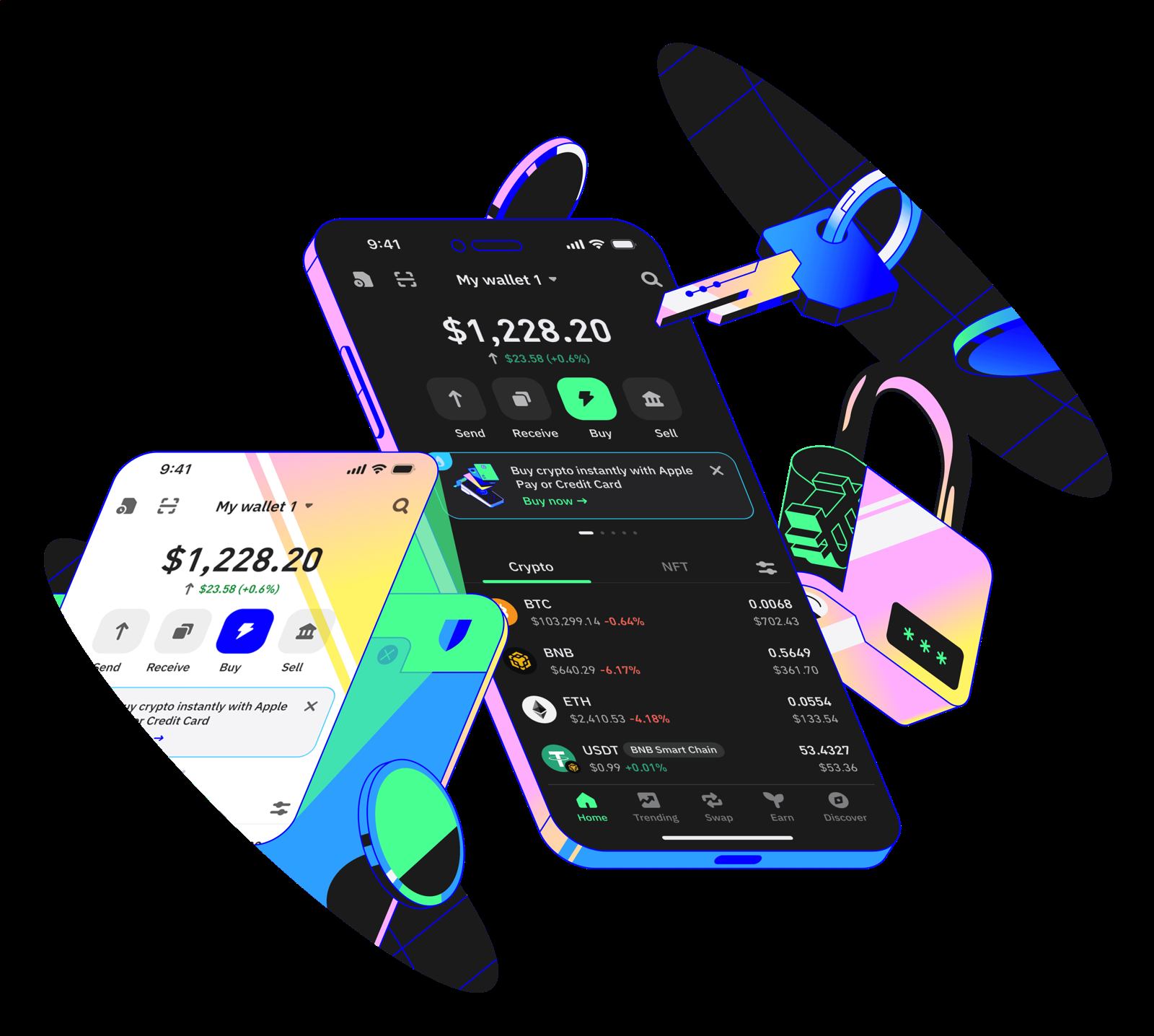
Trustwallet gives users two main entry points: the mobile app for iOS and Android, and a browser extension for desktop Web3 sessions. The mobile version fits the "wallet in your pocket" use case: buying crypto, checking prices, scanning dApps, managing NFTs, and signing transactions while away from a desk. The extension is better suited to desktop DeFi, where users compare markets, inspect contract prompts, and connect to protocols through a wider browser workspace.
The same person might use both modes during a week. They might buy ETH or BNB from the phone, bridge or swap into another asset, then use the desktop extension to interact with a dApp that needs more screen space. That division is important because multi-chain DeFi is no longer one chain, one token, and one app. It is a series of connected account decisions.
Assets, chains, and the multi-chain wallet problem
Multi-chain wallets solve a messy coordination problem: Bitcoin sits in one accounting system, Ethereum assets follow EVM conventions, BNB Chain uses similar tooling, Solana has its own transaction model, and networks such as Polygon, Arbitrum, Optimism, Avalanche, Cardano, and Cosmos-style chains carry different fee tokens, addresses, and signing formats. A broad wallet interface reduces the switching cost between these ecosystems.
In most cases, Trustwallet's public positioning centers on millions of assets and Web3 coverage, so the most valuable use case is not merely storing a single coin. It is keeping a coherent portfolio view while still reaching swaps, staking, NFTs, RWAs, perpetual futures, and prediction markets. Users who hold stablecoins, governance tokens, gas assets, and collectibles need clear separation between account control and app activity. The wallet provides that map.
Swaps and buying crypto inside the same flow
The built-in swap experience matters because DeFi starts with asset placement. A user who holds USDT, USDC, ETH, BNB, SOL, BTC, or another major asset still needs the right token on the right network before interacting with a pool, staking contract, NFT marketplace, or on-chain game. A wallet-level swap flow keeps that routing close to the balance screen and reduces the jump between portfolio review and transaction execution.
Buying crypto inside the app serves a different moment. It helps a new wallet receive a first gas token or adds funds before a trade. Card and payment availability varies by region and provider, while network fees remain a property of the blockchain being used. The important habit is simple: leave enough native gas token on the network where the next transaction will settle.
Staking from a wallet is still chain-specific
Staking inside a self-custody interface connects a wallet address to validator or delegation mechanics on networks that support proof-of-stake rewards. The wallet presents the action, but the chain defines lockups, unbonding periods, reward timing, validator behavior, and claim rules. That is why staking DOT differs from staking SOL, ATOM, BNB, or other supported assets. The interface matters, yet the protocol rules decide the actual timing.
This is the area where users should slow down before signing. Some networks create waiting periods before funds become transferable again, and some staking interfaces expose fewer advanced controls than chain-specific wallets. Trustwallet is convenient for managing many assets in one place, while specialized wallets built for a single network sometimes expose deeper staking details for that ecosystem.
NFTs, RWAs, perpetuals, and prediction markets widen the wallet role
The wallet has expanded beyond coins and token swaps. NFT support gives collectors a place to view digital collectibles and sign marketplace interactions. Tokenized real-world assets bring fund-like or yield-bearing instruments on-chain, with ownership represented as tokens. Perpetual futures and prediction markets add trading experiences where collateral, margin, and settlement live close to the wallet connection.
For context, Trustwallet's newer menu items show where user demand is moving: people want one self-custody account to reach more types of crypto markets. That creates a broader surface area, so readable transaction prompts become as important as asset support. A perpetual trade, an NFT listing, and a tokenized treasury position create very different obligations, even though all of them appear through a wallet confirmation screen.
Approvals are the part worth reading every time
Token approvals determine what a smart contract is allowed to move from a wallet. A swap router needs spending permission for the token being traded. An NFT marketplace needs authority to transfer a listed collectible. A DeFi app might request an allowance that remains active after the first transaction. This is normal Web3 plumbing, but it is also where careless signing creates unnecessary exposure.
- Check which asset the approval covers before confirming.
- Prefer exact or limited allowances when the wallet gives that choice.
- Revoke old permissions after leaving a dApp or market.
- Keep native gas tokens separated from long-term holdings.
- Treat unexpected signature requests as transaction prompts, not pop-ups.
Account abstraction improves wallet UX, but it does not erase the need to understand permissions. SWIFT makes advanced account behavior easier to use; approvals still define what connected contracts receive permission to do.
Getting set up for a first DeFi session
A clean start begins with installation from the official app store or browser-extension listing, then wallet creation or import. New wallets receive a recovery phrase or account setup flow that must be stored privately. After that, the user adds funds, chooses a network, and keeps enough native token for gas. On Ethereum that means ETH; on BNB Chain it means BNB; on Polygon it means POL.
Once funded, the next step is smaller than many users expect. Make one low-value transaction first: a modest swap, a tiny transfer to another address, or a harmless dApp connection. That first action teaches the rhythm of network selection, gas, approvals, and confirmations without putting a large balance into an unfamiliar flow. Trustwallet's strength is breadth, and breadth rewards users who build a simple operating routine.
When MetaMask, Phantom, or Ledger Live is the better comparison
A useful comparison starts with the chain and device habits. MetaMask remains the default reference point for EVM-heavy DeFi across Ethereum, Base, Arbitrum, Optimism, Polygon, and BNB Chain because of its deep dApp compatibility. Phantom feels strongest for Solana-first users and has expanded into Ethereum and Bitcoin support. Ledger Live pairs with Ledger hardware wallets and suits people who prioritize offline signing for long-term storage.
On a practical level, Trustwallet fits users who want a mobile-first, multi-asset wallet with broad Web3 access and an account abstraction path through SWIFT. It is less about being the most specialized interface for one ecosystem and more about keeping many on-chain activities close together. A person focused entirely on Solana NFTs, Polkadot staking controls, or hardware-only custody will compare it against tools built around those narrower jobs.

Building on Wallet Core and developer-facing tools
The project is not only a consumer wallet. Wallet Core is its open-source, mobile-focused wallet library, and developer resources exist for teams that want to integrate wallet functions, list assets, submit dApps, or build around wallet operations. That matters because wallet ecosystems become more useful when external apps follow predictable signing, asset, and connection patterns.
Agent Kit points at another direction: wallet operations that interact with agent-style workflows. As crypto interfaces absorb automation, the key question becomes permission design. A wallet that supports richer operations must still make ownership, approvals, and transaction intent legible. That is the thread connecting SWIFT, dApp access, swaps, staking, and every newer market surface inside Trustwallet.
Frequently asked questions about Trustwallet
Does SWIFT replace a normal recovery phrase in Trustwallet?
SWIFT changes the account model by using smart contract wallet features, but it does not make account recovery something to ignore. The setup flow and recovery method depend on the wallet type chosen during creation. Users should understand the exact recovery path before funding the account, because losing access to the signing method or recovery information still blocks practical control of assets.
Which gas token should I keep before using DeFi through Trustwallet?
The gas token matches the network where the transaction settles. Ethereum uses ETH, BNB Chain uses BNB, Solana uses SOL, and Polygon uses POL. Stablecoins such as USDC or USDT do not replace the chain's native gas asset for most transactions. Keeping a small gas balance on each active network prevents failed swaps, approvals, staking actions, and NFT transfers.
Can I use Trustwallet for Polkadot staking without a separate DOT wallet?
The wallet supports staking features for selected assets, but Polkadot staking has chain-specific rules, bonding mechanics, and unbonding periods. A dedicated Polkadot wallet gives deeper control for users who need advanced staking actions or recovery flexibility. Anyone staking DOT through a general multi-chain wallet should understand how signing, derivation, and unbonding work before committing a large balance.
Fees on Trustwallet swaps: where do the costs come from?
Swap costs come from several places: network gas, the quoted exchange route, price impact, and any provider or aggregator fee shown in the transaction flow. The wallet interface presents the swap, while the underlying chain and liquidity route determine the final economics. Reviewing the quote, minimum received amount, and gas estimate matters more than looking at a single headline price.
Recovering access if a phone with Trustwallet is lost
Recovery depends on the wallet setup. A standard wallet requires the recovery phrase or private-key backup created during setup. A smart wallet may add account abstraction recovery options, but the user still needs the recovery method tied to that account. Losing the device is manageable when the recovery information remains private and intact; losing both device access and recovery data is the serious failure case.
Is the browser extension better than the mobile app for DeFi?
The browser extension is better for desktop dApps, complex position review, and signing while comparing several market pages. The mobile app is better for quick balance checks, payments, simple swaps, NFT viewing, and wallet access away from a desk. Both serve the same broader wallet role; the better choice comes from the screen size and dApp workflow being used.